Street photography and confrontation

In a tube carriage there is nowhere to run.
For many people, the first thing that comes to mind when considering street photography is the sheer audacity of walking around in public taking photos of strangers. Street photography is photography on hard mode and strangers are unpredictable. Combine this with the current and justified state of paranoia around surveillance, data and privacy in a world where a handful of sociopaths with substance abuse issues do everything in their power to make sure Nigel Farage is still getting algorithmic oxygen, it’s no wonder people can be a little prickly.
Street photography is about capturing unscripted, candid moments in public spaces. It is a genre that focuses on the natural ebb and flow of people interacting with each other and their shared environment. Often the results are raw, curious and unexpectedly humorous. The very nature of capturing these moments, and doing them justice is to do so without consent. This creates a social tension, even if most often this tension is only in the photographer's mind as the subject or subjects are often oblivious or indifferent.
It’s this tension that creates a psychological landscape which needs to be navigated with sensitivity, awareness and confidence. Sensitivity and awareness will keep you out of trouble, confidence will keep you pushing for that illusive moment that results in the book deal we all pretend we don’t want.
The unscripted moment
The pursuit of the unscripted moment requires a commitment to authenticity. In a world of staged perfection and curated social media feeds, street photography seeks out these unscripted moments, the quiet glances, sudden laughs, and unfiltered emotions that define human interaction.
When a photographer enters a busy location like Borough Market, which has been feeding Londoners for over a thousand years, they are entering a stage where the drama of daily life unfolds. From the noble quest for the perfect sandwich to the interactions between tourists and vendors, the market offers a diverse array of candid moments. Yet, when a camera is raised, the dynamic can shift. The "unscripted" nature of the scene is threatened by the subject’s awareness of being observed.

Fear
The fear of confrontation is often the single greatest psychological barrier for a street photographer, certainly when new to the genre. However, once you get out with the camera, you realise pretty soon that actually, nobody cares about you or what you are doing. They rarely notice you and if they do they certainly don’t care. Everybody is busy, and nobody likes confrontation, so the chances of you being confronted is very rare. In my 15 years of street photography I’ve only ever been challenged twice, and both times the subject was understanding and all was well.
Avoiding confrontation
The methods to minimise the chances of things getting ugly are numerous and with practice and experience will become second nature. The term "Bruising the scene" was coined by Joel Meyerowitz, an American photographer known for his early use of colour in his street photography. "Bruising the scene" occurs when certain behaviors make subjects notice you, disrupting the candid nature of the environment.
Minimal equipment
Blending into the scene is key, you don't want people to notice the camera, so keep the camera equipment to a minimum. Ideally using a smaller lens and avoiding the larger zoom lenses.
Don’t be sneaky
Avoid wearing bright colours or anything that will catch peoples eye, this includes how you move. Don’t try to be sneaky, or hide what you are doing. Acting furtive, moving strangely, or trying to hide the camera will draw more attention to you, not less. Keeping the camera at chest level reduces the amount of movement required to take the shot. I often walk with my camera resting on my chest, requiring minimal movement when raising it to my eye.
Shoot from the hip
Raising your camera to your eye is a significant gesture that may catch people’s attention. Shooting from the hip is a useful skill to learn, and one that is far easier with the tilting screens on most modern cameras. This technique also has the added benefit of creating more unusual and dynamic angles. Everyone sees the world from eye level, so there are some easy wins when changing the camera's viewpoint. A vital technique when shooting from the hip is to zone focus, this enables you to take photos quickly and keep on the move.

Zone focus
Zone focusing can seem like a very complicated technique, but it is very simple and practical for unobtrusive, fast shooting. It involves manually pre-setting your camera's focus distance and aperture. Doing this ensures the moment is never lost to a slow autofocus system as the camera is always ready, enabling you to capture the scene quickly and keep on the move. It is very useful for shooting from the hip and helps you remain unseen.
My ‘go to’ settings for zone focus are F8, manually setting the focus distance to 4-6 feet using a wider field of view in the 16mm to 28mm range. Utilizing smaller apertures, for example f8, increases the depth of field, making the focus zone larger and more forgiving. Wider lenses provide a significantly deeper zone of focus than longer lenses, so the ‘window’ where the subjects are in focus is deeper and you’ll increase the chances of the subject being in focus.
I won’t get into the technical explanation of how zone focussing works, but a more detailed explanation can be found here, and there are plenty of great YouTube videos on the subject.
Avoid, pretend and adjust settings
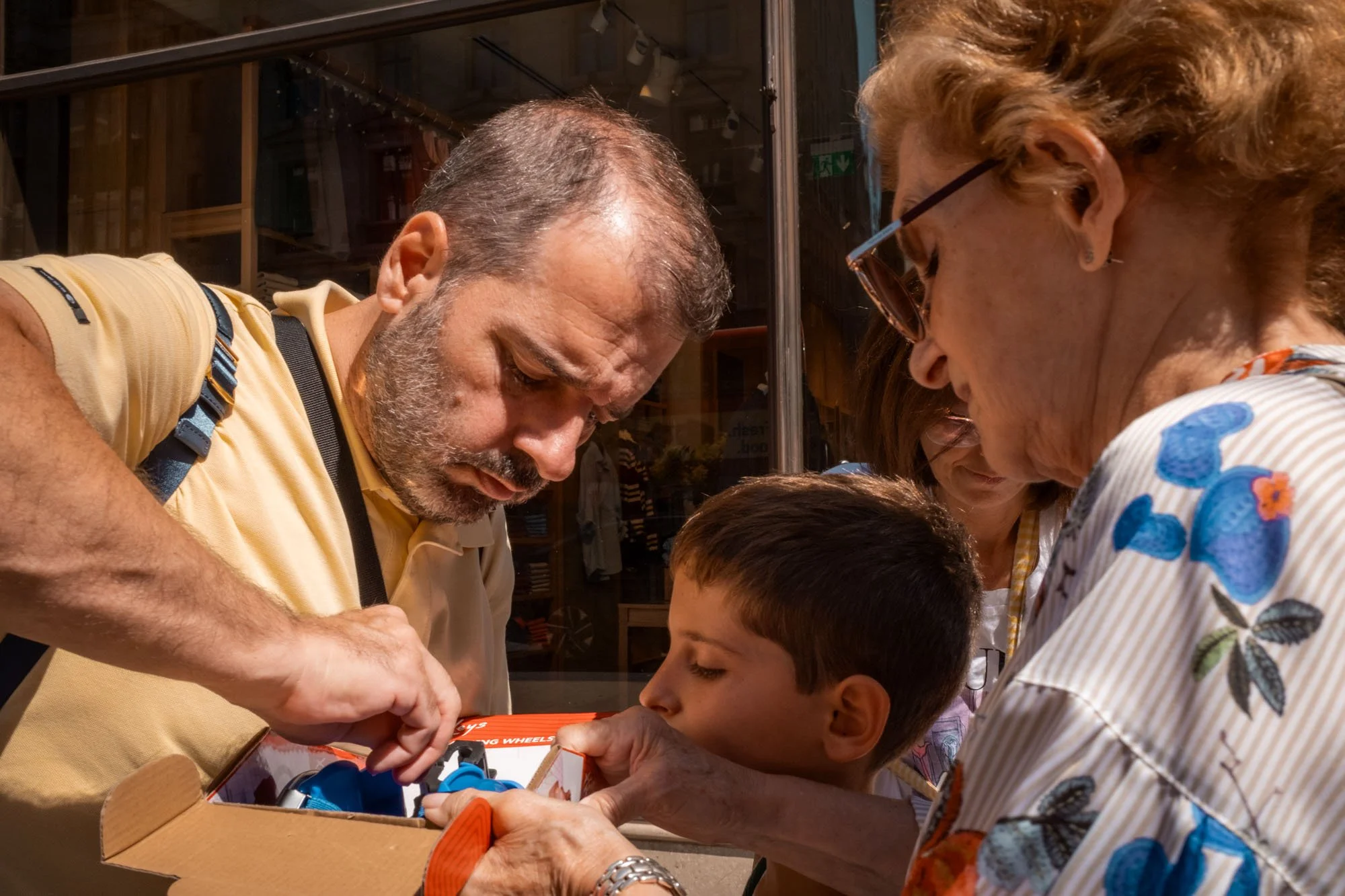
Avoiding eye contact will drastically reduce the chances of an interaction. Looking behind the subject can reduce suspicion, as you pretend you were photographing something behind or to the side of them. If you really want that Oscar, you can pretend to be having trouble with your camera or adjusting its settings. This is the dumb tourist persona, where you appear clueless and therefore not a cause for concern. The best example of this can be found watching the American street photographer Garry Winogrand. A great example can be seen in this video showing how he acts confused and fumbles with his camera after he takes the shot.
Smile, explain and compliment
A smile can diffuse a tense situation in an instant. If you’re seen, and eye contact is made, simply smile and move on. This is the most common scenario you’ll encounter and rarely leads to any additional interaction with the subject. If the subject persists, explain what you're doing and why you took the shot, which is the perfect time to introduce a compliment to further defuse the situation.
Go fishing
Fishing is an incredibly useful technique in street photography. Some photographers almost exclusively use this technique. Simply, fishing involves staying in one place and waiting for something to happen. This is useful for a number of reasons. Firstly, you were there first, so anyone walking into the scene probably won’t even notice you, and if they do, you are just part of the goings on. Secondly, fishing allows you to find a ‘stage’ for your photo. This could be the way the light is interacting with the environment, a colour or building. Some great examples of this technique can be found in the work of Sean Tucker, a UK based photographer, who by his own admission is wary of confrontation so chooses to set the scene and wait.
Use the environment
Protective barriers can be found everywhere, the shop window is a favourite of mine. I’ve been taking pictures through shop windows for years, which has developed into an ongoing series titled ‘Shooting Panes’. A window is a perfect barrier as most importantly you can see through it, and it would take considerable effort for any confrontation to occur.

Persistence
The anxiety will never completely disappear, and why would you want it to? Operating outside your comfort zone is a great way to push yourself and stay sharp. If it was easy, then it wouldn't be worth it. Shoot a lot, as much as you can, take your camera everywhere, as you never know when you might see that moment.
Engaging in online communities like the Framelines Street Photography Community can also be a great source of help and inspiration, the common mindset and discussion can be therapeutic in those times of self doubt and frustration. Engaging with street assignments and receiving practical, hands-on guidance, you can learn to move past the fear of the "frown".